
Part of our complete guide: Maldives Diving & Snorkeling Guide 2026: Sites, Seasons & Resorts
Having spent over 15 years navigating the incredible underwater world of the Maldives, exploring more than 40 resorts and local islands, I can confidently say that this archipelago offers some of the planet's most exhilarating diving. From heart-pounding channel drifts teeming with sharks to serene thilas where manta rays gracefully dance, the Maldives is a diver's paradise. But with over 1,000 coral islands spread across 26 atolls, knowing where to drop in can be overwhelming. This guide, based on my extensive experience, cuts through the noise to bring you the 25 best dive sites in the Maldives for 2026, complete with depths, difficulty, marine life you can expect, and the optimal months to visit.
Whether you're an Open Water beginner or an Advanced Open Water pro seeking the next big thrill, the Maldives delivers. Expect year-round warm water temperatures of 27-30°C and visibility often stretching between 20-40 meters, making every dive a visual feast.
North Male Atoll: The Gateway to Maldivian Diving
North Male Atoll is often the first stop for many divers, thanks to its proximity to Velana International Airport (MLE). Don't let its accessibility fool you; this atoll boasts some truly world-class sites.
1. Banana Reef (Gaathugiri)
- Depth: 5-30 meters (16-100 feet)
- Difficulty: Beginner to Advanced (currents can be moderate to strong)
- Marine Life: Schools of snapper, oriental sweetlips, barracudas, reef sharks, moray eels, and vibrant soft corals.
- Best Months: Year-round, with peak visibility from December to April.
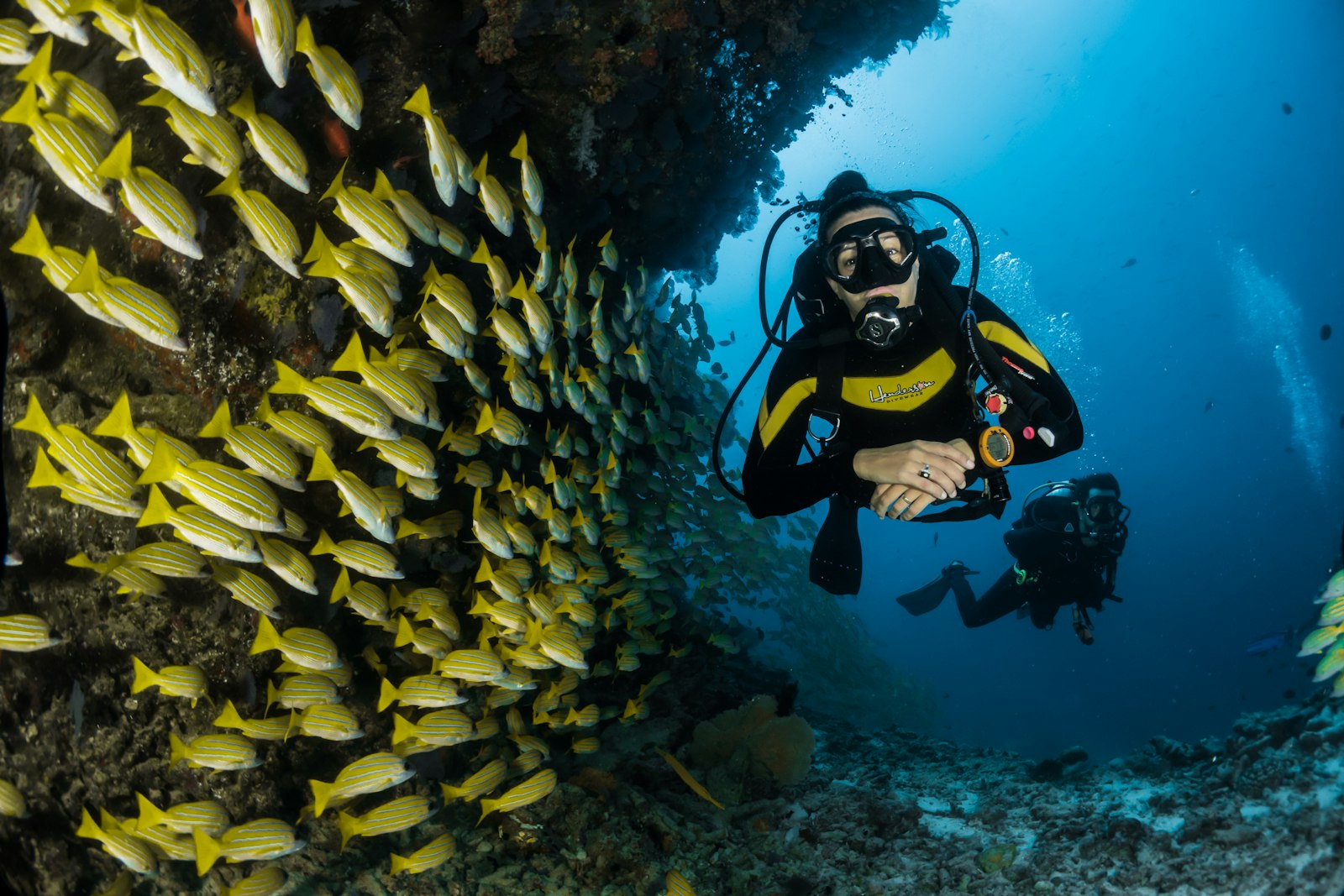
Banana Reef, one of the Maldives' first protected marine areas, is a classic for a reason. Its distinctive curved shape hides dramatic overhangs, caves, and steep drop-offs. On my last visit, I spent a good 20 minutes just watching a massive school of yellow snapper swirl around a coral pinnacle. It's an excellent site for photographers due to the diverse topography and abundant reef fish.
2. HP Reef (Girifushi Thila)
- Depth: 7-30 meters (23-100 feet)
- Difficulty: Intermediate to Advanced (can have strong currents)
- Marine Life: Soft corals in every imaginable color, schooling trevallies, barracudas, tuna, and grey reef sharks.
- Best Months: December to April for best visibility.
Also known as "Rainbow Reef" or "Girifushi Thila," HP Reef is a kaleidoscope of soft corals, especially impressive when the current is mild. When currents pick up, it becomes a hub for pelagic action. I've often seen grey reef sharks patrolling the deeper sections here, making for an exciting drift. This site is a visual feast, but good buoyancy is key to avoid damaging the delicate corals.
3. Manta Point (Lankanfinolhu)
- Depth: 10-25 meters (33-82 feet)
- Difficulty: Easy to Intermediate
- Marine Life: Manta rays (cleaning station), reef sharks, moray eels, schooling fusiliers.
- Best Months: May to November for consistent manta sightings.
Lankanfinolhu Manta Point is a renowned cleaning station where these majestic giants come to be serviced by cleaner wrasse. It's a truly humbling experience to witness dozens of mantas gracefully circling overhead. I've snorkeled this reef dozens of times, but seeing it from below, watching the mantas hover almost motionless, is something else. This is a must-do, particularly during the southwest monsoon when plankton blooms attract them in droves.
4. Maldives Victory Wreck
- Depth: 12-35 meters (39-115 feet)
- Difficulty: Advanced (due to depth and potential currents)
- Marine Life: Lionfish, batfish, snappers, groupers, moray eels, and vibrant coral growth on the wreck.
- Best Months: December to April for calmest conditions.
The Maldives Victory is a 110-meter cargo ship that sank in 1981, now lying upright and heavily encrusted with corals. It's a challenging dive, often with strong currents, but incredibly rewarding. Exploring the bridge and cargo holds, while keeping an eye out for the large batfish that call it home, is an unforgettable experience. This site truly requires good buoyancy and wreck diving experience.
5. Kuda Haa
- Depth: 5-30 meters (16-100 feet)
- Difficulty: Easy to Intermediate
- Marine Life: Nudibranchs, ghost pipefish, frogfish, reef sharks, turtles.
- Best Months: Year-round.
A smaller pinnacle (thila), Kuda Haa is known for its macro life and diverse reef fish. It's a fantastic site for photographers looking for smaller critters, but also offers good chances for larger reef inhabitants like sharks and turtles. The currents can be mild, making it a relaxed and enjoyable dive.
South Male Atoll: Channel Dives and Pelagic Action
South Male Atoll is famous for its current-swept channels, which act as highways for large pelagic species. If you're looking for sharks and eagle rays, this is a prime location.
6. Kandooma Thila (Cocoa Thila)
- Depth: 12-40 meters (39-131 feet)
- Difficulty: Advanced (strong currents)
- Marine Life: Grey reef sharks, whitetip reef sharks, eagle rays, barracudas, dogtooth tuna, schools of jackfish and snapper, vibrant soft corals.
- Best Months: November to April for clearer waters and consistent pelagic action.
Kandooma Thila, often considered one of the best dive sites in the South Male Atoll, is an adrenaline rush. This teardrop-shaped pinnacle, located in a wide channel, is a magnet for sharks and eagle rays, especially during incoming currents. I've had dives here where I've seen dozens of grey reef sharks patrolling the cleaning station. It's a full-on drift dive, so be prepared for strong currents and bring a reef hook.
Pro Tip: Mastering the Current
Maldivian channel dives, like Kandooma Thila or Fotteyo Kandu, are incredible but demand good current diving technique. Always listen carefully to your dive guide, maintain good buoyancy, and be ready to use a reef hook to secure yourself and enjoy the show. Practicing your drift diving skills before your trip can make a huge difference.
7. Cocoa Corner
- Depth: 12-53 meters (39-174 feet)
- Difficulty: Intermediate to Advanced (moderate to strong currents)
- Marine Life: Grey reef sharks, whitetip reef sharks, eagle rays, tuna, barracudas, vibrant soft corals, overhangs.
- Best Months: November to April for best conditions.
Located near Kandooma Thila, Cocoa Corner is another fantastic channel dive known for its dramatic topography and rich marine life. The dive changes character with the tide; during incoming currents, you'll find plenty of pelagics. I recall a dive here where we were surrounded by a school of blue-striped snappers, with eagle rays gliding gracefully in the blue. It's an exhilarating drift, offering stunning views of soft corals in the overhangs.
8. Guraidhoo Corner
- Depth: 10-30 meters (33-100 feet)
- Difficulty: Advanced (strong currents)
- Marine Life: Grey reef sharks, whitetip reef sharks, eagle rays, schooling trevallies, snappers, and turtles.
- Best Months: Year-round, with enhanced pelagic action during current-rich periods.
Guraidhoo Corner is part of a large marine protected area and offers a complex of channels and reefs. It's a classic Maldivian channel dive, often with powerful currents that bring in the big fish. I've seen impressive schools of jacks and snappers here, along with the ever-present reef sharks. It's an excellent site for experiencing the raw power of the ocean currents and the marine life they attract.
9. Embudu Express (Embudu Channel)
- Depth: 12-30 meters (39-100 feet)
- Difficulty: Advanced (very strong currents)
- Marine Life: Grey reef sharks, eagle rays, barracudas, tuna, and large schools of fish.
- Best Months: November to April for best visibility, but strong currents can occur year-round.
Embudu Express is a high-octane drift dive through a channel known for its very strong currents. This site is for experienced divers only, as you'll be flying past the reef. The reward? Incredible pelagic encounters. I've had some of my most thrilling shark sightings here, with grey reef sharks cruising effortlessly against the flow. It's a commitment, but the payoff is immense.
Ari Atoll (North & South): Whale Sharks, Mantas & Pinnacles
Ari Atoll is arguably the most famous atoll for big animal encounters, particularly whale sharks and manta rays. It's a must-visit for any serious diver.
10. Maaya Thila
- Depth: 6-30 meters (20-100 feet)
- Difficulty: Intermediate to Advanced (can have strong currents, especially at night)
- Marine Life: Whitetip reef sharks (especially at night), grey reef sharks, turtles, moray eels, frogfish, ghost pipefish, barracudas, trevallies.
- Best Months: Year-round, with peak visibility from December to April.
Maaya Thila is often called the "shark factory" and is legendary for its night dives. Descending into the darkness to find dozens of whitetip reef sharks hunting is an unforgettable experience. Even during the day, it's a vibrant pinnacle teeming with life, from macro critters to larger pelagics. On my last visit to North Ari, a night dive here was easily the highlight.
11. Fish Head (Mushimasmingili Thila)
- Depth: 10-30 meters (33-100 feet)
- Difficulty: Advanced (strong currents)
- Marine Life: Grey reef sharks (many!), schools of blue-striped snapper, barracudas, trevallies, Napoleon wrasse.
- Best Months: December to April for best conditions.
Fish Head is another iconic shark dive, a protected marine area that consistently delivers grey reef shark encounters. It's a deeper thila, and you'll often find yourself hooking in against a strong current, watching the sharks patrol the reef slopes. This site is a testament to the healthy shark populations in the Maldives and a must for shark enthusiasts.
12. Broken Rock
- Depth: 10-30 meters (33-100 feet)
- Difficulty: Intermediate to Advanced (moderate currents)
- Marine Life: Napoleon wrasse, turtles, moray eels, diverse reef fish, and a unique canyon formation.
- Best Months: Year-round.
Broken Rock gets its name from a distinctive canyon that splits the reef, creating a swim-through. This unique topography provides shelter and interesting currents, attracting a variety of marine life. It's a fantastic site for exploring crevices and finding hidden critters, while also keeping an eye out for larger fish cruising by. I always enjoy the intricate swim-through here.
13. Kudarah Thila
- Depth: 10-30 meters (33-100 feet)
- Difficulty: Intermediate to Advanced (can have strong currents)
- Marine Life: Grey reef sharks, whitetip reef sharks, eagle rays, schooling fusiliers, soft corals.
- Best Months: December to April.
Kudarah Thila is a beautiful underwater pinnacle known for its vibrant soft corals and abundant fish life. It's a popular site on liveaboard itineraries and offers excellent opportunities for seeing reef sharks and eagle rays. The currents can be challenging, but they bring in the nutrients that sustain this thriving ecosystem.
14. Rangali Madivaru (Manta Cleaning Station)
- Depth: 10-25 meters (33-82 feet)
- Difficulty: Easy to Intermediate
- Marine Life: Manta rays (cleaning station), reef sharks, turtles.
- Best Months: May to November for mantas.
This is another prime manta cleaning station in South Ari Atoll, particularly famous during the southwest monsoon. Divers can settle in and watch the mesmerizing ballet of mantas queuing up for their clean. It's truly a magical experience and one that never gets old, no matter how many times I've witnessed it.
Read more about Maldives Manta Ray Season 2026: When & Where to See Them.
15. Maamigili Beyru (Whale Shark Drift)
- Depth: 5-15 meters (16-50 feet)
- Difficulty: Easy to Intermediate
- Marine Life: Whale sharks (year-round aggregation), reef fish.
- Best Months: Year-round, with peak sightings during the southwest monsoon (May-November) in South Ari.
Maamigili Beyru, within the South Ari Marine Protected Area, is one of the most reliable spots in the world for whale shark encounters. Unlike some other locations, these encounters are often scuba-compatible, allowing for incredible underwater photography. On one training dive in South Ari, I was with two Open Water students at the safety stop when two whale sharks appeared out of the blue and swam straight towards us. We actually had to move aside to avoid contact. It was only their fourth dive ever, and they surfaced completely speechless!
For more details, see our guide on Whale Shark Snorkeling Maldives 2026: South Ari Guide.
Rasdhoo Atoll: Hammerhead Heaven
Rasdhoo Atoll, a small but mighty atoll west of North Male, is synonymous with one thing: hammerhead sharks.
16. Hammerhead Point (Madivaru Corner)
- Depth: 25-30+ meters (82-100+ feet)
- Difficulty: Advanced (deep, strong currents, early morning dive)
- Marine Life: Scalloped hammerhead sharks (best at dawn), grey reef sharks, eagle rays, tuna.
- Best Months: December to April for peak hammerhead season.
Hammerhead Point is the holy grail for many divers. It requires an early morning start (often before sunrise) and a deep descent to the edge of the blue, where you wait for schools of scalloped hammerheads to emerge from the depths. It's a truly special, almost spiritual experience. While not a guaranteed sighting, the thrill of the chase and the potential reward make it one of the Maldives' most iconic dives.
Vaavu Atoll: Channels and Nurse Sharks
Vaavu Atoll is one of the less developed atolls, offering pristine channel dives and unique night encounters.
17. Fotteyo Kandu
- Depth: 15-40 meters (50-131 feet)
- Difficulty: Advanced (very strong currents)
- Marine Life: Grey reef sharks, whitetip reef sharks, eagle rays, tuna, barracudas, soft coral overhangs, unique cave formations.
- Best Months: December to April for best visibility and pelagic activity.
Fotteyo Kandu is consistently ranked as one of the best channel dives in the world. The currents here can be ferocious, but they bring in an incredible amount of marine life. Overhangs draped in soft corals, caves, and a constant parade of sharks and eagle rays make this a high-energy, unforgettable dive. I've often seen grey reef sharks holding their position against the current, creating a spectacular wall of fins.
18. Miyaru Kandu
- Depth: 15-35 meters (50-115 feet)
- Difficulty: Advanced (strong currents)
- Marine Life: Grey reef sharks, whitetip reef sharks, occasional hammerheads, eagle rays, tuna, and diverse reef fish.
- Best Months: December to April.
Miyaru Kandu, meaning "Shark Channel" in Dhivehi, lives up to its name. It's another thrilling channel dive in Vaavu Atoll, known for spectacular shark action. While grey reef sharks are common, lucky divers can also spot hammerheads, especially at dawn. The deep channel walls and strong currents create perfect conditions for pelagic species.
19. Alimatha Jetty (Night Dive)
- Depth: 5-15 meters (16-50 feet)
- Difficulty: Easy to Intermediate (no current)
- Marine Life: Hundreds of nurse sharks, stingrays, giant trevallies.
- Best Months: Year-round.
Alimatha Jetty offers one of the most unique and accessible night dives in the Maldives. Under the resort lights, hundreds of nurse sharks and stingrays gather, creating an almost surreal underwater spectacle. It's a fantastic experience even for less experienced night divers, and I highly recommend it for anyone wanting a truly different shark encounter.
Lhaviyani Atoll: Currents and Turtles
Lhaviyani Atoll is known for its strong currents and healthy populations of turtles and pelagic fish.
20. Kuredu Express
- Depth: 20-35 meters (66-115 feet)
- Difficulty: Intermediate to Advanced (strong currents)
- Marine Life: Grey reef sharks, eagle rays, tuna, barracudas, green turtles (often resting on ledges), occasional hammerheads.
- Best Months: Year-round, but stronger currents (May-Oct) can bring more pelagic activity.
Kuredu Express is a thrilling drift dive through a sandy channel. The "Express" in its name is no exaggeration; the currents can be incredibly swift. It's a fantastic site for watching large pelagics, and I've often seen numerous green turtles cruising or resting in the canyon at around 20 meters. It's a dynamic dive where the reef seemingly flies by.
21. The Shipyard
- Depth: 15-28 meters (50-92 feet)
- Difficulty: Intermediate
- Marine Life: Butterflyfish, damselfish, glassfish, small blennies, groupers, moray eels, ribbon eels, macro life (ghost pipefish, frogfish, leaffish), and vibrant coral growth on two wrecks.
- Best Months: Year-round.
The Shipyard offers two fascinating wrecks, Skipjack 1 and Skipjack 2, both covered in colorful corals and teeming with reef fish. While not as deep or dramatic as the Victory Wreck, they provide excellent opportunities for wreck exploration and macro photography. I always find something new here, from nudibranchs to hidden moray eels.
Baa Atoll: UNESCO Biosphere Reserve & Manta Capital
Baa Atoll is a UNESCO Biosphere Reserve, globally renowned for its incredible biodiversity, especially during the manta and whale shark season.
22. Hanifaru Bay (Snorkeling Only)
- Depth: 1-5 meters (3-16 feet)
- Difficulty: Easy (snorkeling only, strict regulations)
- Marine Life: Hundreds of manta rays, whale sharks.
- Best Months: May to November (peak June-October) for manta and whale shark feeding aggregations.
While primarily a snorkeling site, Hanifaru Bay is too iconic not to mention for any dive enthusiast visiting Baa Atoll. During the southwest monsoon, this bay becomes the world's largest known manta ray feeding aggregation. I've witnessed hundreds of mantas barrel-rolling to feed on plankton – it’s an absolutely breathtaking spectacle. Strict regulations mean no scuba diving is allowed, but the snorkeling experience is profound.
23. Dhonfanu Thila
- Depth: 10-30 meters (33-100 feet)
- Difficulty: Intermediate to Advanced (can have strong currents)
- Marine Life: Grey reef sharks, eagle rays, schooling fish, vibrant soft corals.
- Best Months: Year-round, especially good during the northeast monsoon.
Dhonfanu Thila is a beautiful pinnacle dive in Baa Atoll, offering healthy coral gardens and good chances for pelagic encounters. When currents are running, you can expect to see reef sharks and eagle rays. It's a great example of the vibrant thila diving that the Maldives is famous for.
Addu Atoll: The Deep South & British Loyalty Wreck
Addu Atoll, in the deep south, offers a different flavor of Maldivian diving, including the country's largest wreck.
24. British Loyalty Wreck
- Depth: 16-33 meters (52-108 feet)
- Difficulty: Intermediate
- Marine Life: Large groupers, batfish, lionfish, moray eels, turtles, and extensive coral growth on the wreck.
- Best Months: Year-round, generally calmer conditions in the south.
The British Loyalty is the Maldives' premier wreck dive, a 140-meter oil tanker sunk during WWII. It lies on its port side, heavily encrusted with hard and soft corals, providing a home for an incredible array of marine life. It's a fascinating historical dive with plenty to explore, from its massive propeller to the various entry points into its holds. I always recommend this for wreck enthusiasts.
Fuvahmulah Atoll: Tiger Shark Capital
Fuvahmulah, a unique single-island atoll in the far south, is a specialist destination known for its year-round tiger shark encounters.
25. Tiger Zoo (Fuvahmulah Harbour)
- Depth: 8-20 meters (26-66 feet)
- Difficulty: Advanced (due to open ocean exposure and specific protocols)
- Marine Life: Tiger sharks (year-round), thresher sharks (peak March-April), oceanic mantas, whale sharks, silvertip sharks, grey reef sharks.
- Best Months: Year-round for tiger sharks; March-April for thresher sharks; May-November for oceanic mantas.
Fuvahmulah is in a league of its own. "Tiger Zoo" is a dedicated dive where you can reliably encounter tiger sharks, often multiple individuals, in their natural environment. It's a highly controlled dive with strict safety protocols, but the experience is unparalleled. Beyond tigers, Fuvahmulah offers opportunities for thresher sharks, oceanic mantas, and even whale sharks. It's an advanced-only destination, but for serious shark divers, it's a dream come true.
Pro Tip: Liveaboard vs. Resort Diving in 2026
For truly experiencing a wide range of these top dive sites, especially those in more remote atolls, a liveaboard is often the best choice. A 7-night liveaboard in 2026 can range from $2,500 to $4,500 USD per person, including accommodation, meals, and typically 3-4 dives per day with unlimited nitrox. Resort diving, while convenient, usually limits you to sites within a 30-60 minute boat ride. A single boat dive from a resort in 2026 can cost around $70-$95 USD (excluding equipment rental, which is usually $20-$30 USD per day).
Planning Your 2026 Maldives Dive Trip
Choosing your dive sites is just the first step. Here's some actionable advice:
- Certification: While some sites are beginner-friendly, many of the most exhilarating dives, especially the channel and deeper thila dives, require Advanced Open Water certification and experience with currents. If you're planning for sites like Fotteyo Kandu or Fish Head, consider getting certified up to Advanced Open Water before you arrive. Learn more about PADI Certification in Maldives 2026: Courses & Costs.
- Transfers: Factor in transfer times and costs. Domestic flights to places like Fuvahmulah can cost around $150-$250 USD one-way, while speedboat transfers to nearby atolls like South Male can be $30-$80 USD per person.
- Dive Insurance: Mandatory for all serious diving. Ensure your travel insurance covers scuba diving up to your planned depths.
- Book in Advance: Especially for liveaboards and popular dive resorts, 2026 bookings are filling up. Secure your spot early to avoid disappointment.
The Maldives is an unparalleled destination for scuba diving, offering a diversity of marine life and underwater topography that few places can match. From the bustling channels of South Male to the hammerhead schools of Rasdhoo and the tiger sharks of Fuvahmulah, every atoll holds its own unique treasures. I've been fortunate enough to explore these waters for years, and each dive still brings a sense of wonder. Pack your fins, hone your skills, and prepare for the dive trip of a lifetime.
Ready to explore these incredible dive sites?
Check out some of my favorite dive-centric resorts:
Book Baros Maldives
Check Best Prices →
Book Soneva Jani
Check Best Prices →
Book Ellaidhoo Maldives By Cinnamon
Check Best Prices →
Pro Tip: Respecting Marine Life
Always maintain a respectful distance from marine life. Never touch corals or animals, and avoid disturbing their natural behavior. This ensures these incredible ecosystems remain healthy for future generations of divers. This is particularly important at cleaning stations and feeding aggregations.
Frequently Asked Questions About Diving in the Maldives (FAQ)
What is the best time of year for diving in the Maldives?
The best time for diving in the Maldives is generally during the Northeast Monsoon, from December to April. This period offers calm seas, excellent visibility (20-40 meters), and reliable conditions for spotting pelagics. However, the Southwest Monsoon (May to November) can be excellent for manta ray and whale shark sightings due to increased plankton, particularly in specific atolls like Baa and South Ari.
Do I need to be an advanced diver to dive in the Maldives?
Not for all sites, but many of the most famous and thrilling dives, especially the channel dives and deeper thilas with strong currents, do require an Advanced Open Water certification and experience with drift diving. Beginner-friendly sites and house reefs are abundant, particularly in North Male Atoll, but for the full Maldivian experience, advanced skills are highly recommended.
What marine life can I expect to see in the Maldives?
The Maldives is renowned for its incredible diversity of marine life, including manta rays, whale sharks, various species of reef sharks (grey reef, whitetip, blacktip), hammerhead sharks, tiger sharks (in Fuvahmulah), eagle rays, turtles (green and hawksbill), Napoleon wrasse, barracudas, tuna, and vast schools of colorful reef fish.
Are liveaboards or resorts better for diving in the Maldives?
Both offer fantastic diving experiences. Liveaboards are generally preferred for divers who want to maximize their dive count, explore a wider range of atolls and more remote sites, and focus solely on diving. Resorts offer convenience, luxury, and often excellent house reefs, but their dive sites are limited to the immediate vicinity. Your choice depends on your budget, priorities, and desired level of comfort.
How much does diving cost in the Maldives in 2026?
A single boat dive from a resort in 2026 typically costs between $70-$95 USD, excluding equipment rental. Dive packages for multiple dives offer better value, with 10-dive packages ranging from $500-$800 USD. Liveaboard trips for 7 nights in 2026 can range from $2,500 to $4,500 USD per person, often including accommodation, all meals, and 3-4 dives daily with nitrox.
What are the best atolls for specific marine life encounters?
For whale sharks, South Ari Atoll (especially Maamigili Beyru) is the most reliable year-round. For manta rays, Baa Atoll (Hanifaru Bay for snorkeling) and North/South Ari Atoll (cleaning stations like Lankanfinolhu and Rangali Madivaru) are prime. For hammerhead sharks, Rasdhoo Atoll (Hammerhead Point) is the place for early morning dives. For tiger sharks, Fuvahmulah Atoll in the Deep South is the specialist destination.